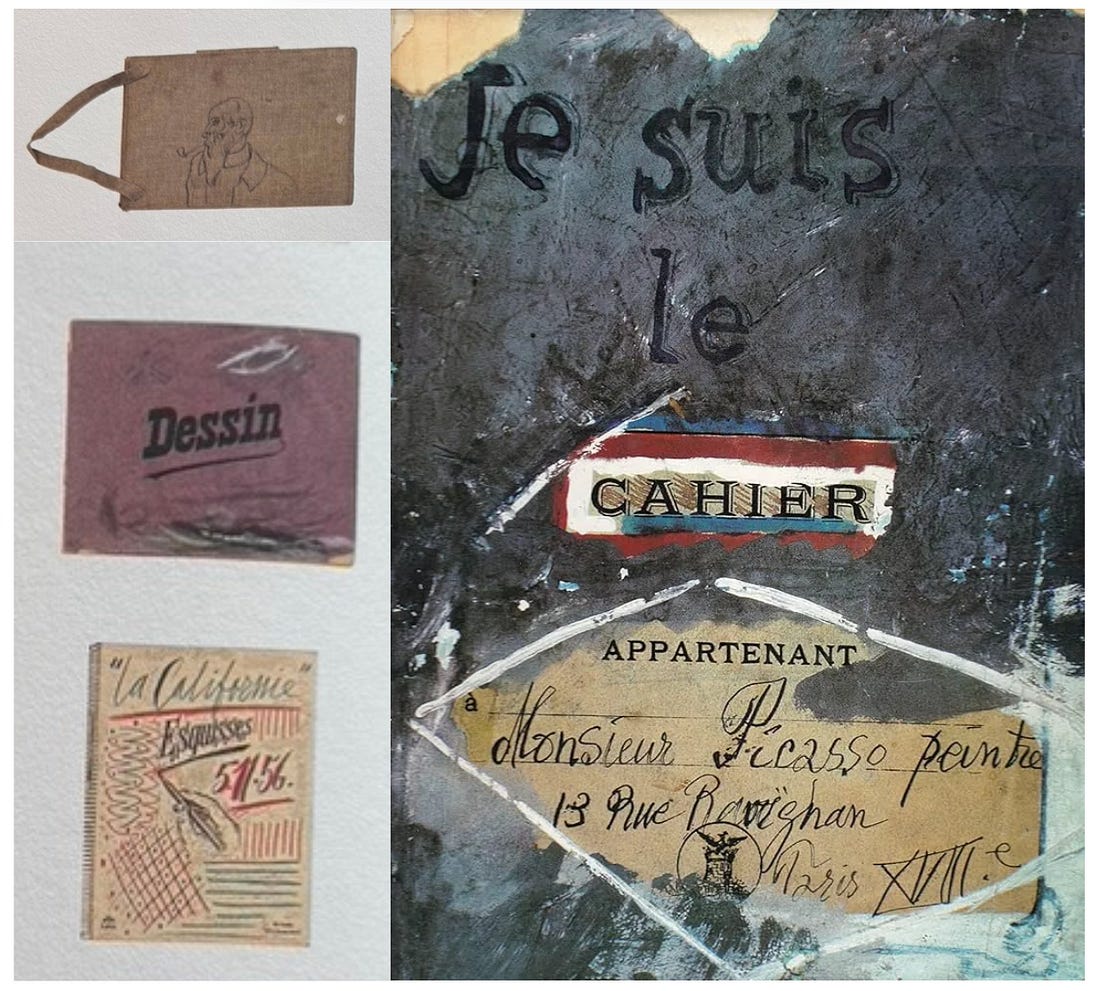
The first time I walked into a Picasso exhibit, I made the mistake most people make. I went straight for the canvases on the walls. The big ones. The ones with the placards. I treated the sketchbooks behind the glass cases like footnotes, the way you scan a bibliography on the way out of a library.
It took me a few more visits, and then a long obsession with a book called Je suis Le Cahier: The Sketchbooks of Picasso, to realize I had the whole thing backwards. The paintings were the footnotes. The notebooks were the work.
Between 1894 and 1967, Pablo Picasso (1881-1973) filled 175 sketchbooks. He started as a teenager doodling pigeons in the margins of his school books and never stopped. He inscribed one of them with three words that I have been thinking about ever since I read them:
Je suis le cahier.
[I am the notebook.]
Source: Je suis Le Cahier: The Sketchbooks of Picasso, Atlantic Monthly Press, 1986.
That line is doing a lot of work. It is not a slogan or a quip. It is the closest thing we have to Picasso’s theory of where his art actually lived. Not on the easel. Not in the museums. In the cheap bound notebooks he carried around for seven decades. This article is about what those 175 notebooks teach the rest of us about practice, repetition, and the unglamorous middle of any creative life. None of these lessons require a paintbrush. All of them belong inside the journaling habits of successful people I keep coming back to.
1. The Notebook Is the Studio, Not the Showroom

A working page from one of Picasso’s sketchbooks – a figure marked up with proportion lines rather than a finished drawing. Source: Musée Picasso Paris.
There is a quote from Picasso that the editors of Je suis Le Cahier put near the front of the book, and it changed how I think about my own pages:
I picked up my sketchbooks daily, saying to myself: “what will I learn of myself that I didn’t know.”
Source: Picasso, quoted in Je suis Le Cahier: The Sketchbooks of Picasso, Atlantic Monthly Press, 1986, p. 2.
Read that twice. He did not say, “what will I produce today.” He said, “what will I learn of myself that I didn’t know.” The notebook was a daily instrument of self-discovery, not a daily quota.
His son, Claude Picasso, described the notebooks in a memoir as “stepping-stones to trampolines for somersaults.” I love that line because it captures something true about journaling that the productivity industry usually misses. The page is not where you display your jumps. It is where you practice falling.
When I started journaling seriously, I treated each entry like a small published essay. Complete sentences. Tidy conclusions. Nothing too embarrassing. Picasso’s sketchbooks are full of half-faces, smudges, abandoned hands, and pages where the same nose appears nine times in slightly different shapes. The work happens in that mess. The same instinct shows up in Leonardo da Vinci’s notebooks, the original visual journals – he, too, treated paper as the place to think, not the place to finish.
Try this tonight: open your notebook and write, at the top of the page, “What will I learn of myself that I didn’t know?” Then write for fifteen minutes without correcting yourself. The point is not the entry. The point is the question.
2. Repetition Is the Work, Not the Warm-Up

Picasso began working with shapes that did not necessarily belong together. Source: Musée Picasso Paris.
Picasso did not make Les Demoiselles d’Avignon in a single inspired sitting. He carried out 809 preliminary studies across 16 different sketchbooks before he touched the final canvas. Eight hundred and nine. For one painting.
Most of those studies were the same handful of figures, redrawn and redrawn. A face from this angle, then that angle. A torso shifted six inches to the left. The same nose in profile, in three-quarter view, then collapsed into a geometric shape that no nose had ever been before. The Picasso scholar Carsten-Peter Warncke notes that across these sketches, Picasso was building “a repertoire” he could pull from for Les Demoiselles and the paintings that followed.
I used to think repetition in a notebook meant I was stuck. Now I think it means I am working. Writers do this with introductions. I tend to draft three or four openings to anything important before I find the one that holds. So do you, probably, even if you do not call it that. Picasso just refused to be embarrassed by the process.
This is the same pattern that turns up in Bruce Lee’s notebooks, where the same techniques get rewritten on page after page. The repetition is not the residue of skill. It is how the skill arrives.
Reader prompt: pick one thing – a fear, a sentence, a sketch of your week ahead – and write it five times in a row. Change one detail each time. Notice which version is closest to the truth.
3. Bad Drawings Are a Feature, Not a Bug

As a child, he was so obsessed with drawing that he often got into trouble just to have time alone with his sketchbook. Even when he wasn’t working on his sketchbooks, he was still sketching. Source: Musée Picasso Paris.
The most freeing thing about flipping through reproductions of Picasso’s sketchbooks is how many bad drawings are in them. Wonky proportions. Cramped little figures. Heads too big for their bodies. Faces that look like a five-year-old got hold of his pencil.
He was a virtuoso who could imitate any classical style by his teenage years – his father, the academic painter José Ruiz y Blasco, had trained him hard – and yet he chose to fill his notebooks with what looks like deliberately ugly work. That choice was the practice. The bad drawings created the room the breakthroughs needed.
The art historian Marilyn McCully has documented this clearly in her work on the early sketchbooks. Picasso filled his school books with marginal drawings of pigeons, mocking sketches of teachers, and rough cartoons. He was building reps before anyone was looking, the way a young writer fills a notebook with terrible sentences in order to find one good one.
I think about this every time I catch myself trying to write a clean entry on the first try. The page should look used, not framed.
4. Cross-Pollination Beats Isolation

Critics agree that Picasso used his notebooks to work on discrete artistic problems ranging from stylistic to thematic issues. Source: Musée Picasso Paris.
One of the more underrated things about Picasso’s notebooks is how often the same image jumps between books, decades, and finished paintings. A figure he drew in 1907 for Les Demoiselles turns up, transformed, in a still life in the 1920s. A bullfight scene first scribbled in his teens reappears in his work after the Spanish Civil War.
The notebooks were not waste paper. They were a personal archive he visited. He let his earlier self talk to his current self. That is part of what makes the Je suis le cahier line so striking. The notebook is not a record of the person. The notebook is the person, carried forward through time.
This is the same trick you see in Albert Einstein’s notebooks, where ideas surface, vanish, and return years later. The page becomes a long conversation with yourself.
In 2010, the Clark Art Institute mounted an exhibition called Picasso Looks at Degas that made this very visible. Curators paired Picasso’s sketches with the Degas works that had haunted him for decades. You could see Picasso, in his eighties, returning to drawings and themes he had first wrestled with as a young man. The notebook is what made that conversation possible. Without it, the older Picasso would not have had a younger Picasso to argue with.
Reader prompt: flip back to a notebook from six months or six years ago. Find one sentence, sketch, or list. Copy it onto today’s page. Write underneath: “What did I not understand here?”
5. The Same Subject, Drawn Until It Surrenders

A page from Picasso’s sketchbooks showing the same subject reworked across multiple studies. Source: Musée Picasso Paris.
When you look at the Carnet 91 and the other catalogued sketchbooks Picasso used in the run-up to a major work, one habit stands out. He would draw the same subject dozens of times, refusing to release it until it had given him something he did not start with.
Two central figures from Les Demoiselles show up in the sketchbooks over and over again. Picasso starts with realistic proportions he learned at the academy. Then he stretches one shoulder. Then he flattens the face. Then he puts the nose in profile while the eyes look forward. Then he tries that same maneuver on the woman next to her. He is not drawing what the body looks like. He is finding out what the page will let him do.
This is what I have come to think of as “drawing until it surrenders.” You take a subject – a worry, a project, a person, a question – and you write it again and again, in variation, until it loosens its grip. Most of us give up at the second or third attempt because we are bored or self-conscious. Picasso’s notebooks are a reminder that the breakthrough is usually somewhere around attempt 47.
A version of the same discipline runs through Thomas Edison’s structured notebooks, where the same problem gets attacked from dozens of angles. Different medium, identical habit.
6. Pressing Through to the Next Page

Overlapping figure studies on a single sketchbook page – the same forms drawn again and again until one version held. Source: Musée Picasso Paris.
There is a small technical detail in Picasso’s notebooks that I cannot stop thinking about. The scholar Marilyn McCully describes how Picasso, while sketching, would press hard enough with his pencil to leave a ghost imprint on the page beneath. When he turned the page, he had a faint outline already waiting for him, and he would draw the same form again on top of that ghost, slightly different.
It is a tiny mechanical trick. It is also a metaphor that explains his whole practice. Every page leaves a trace in the page that follows. You do not start from blank. You start from a faint version of where you just were, and you push it forward by one more degree of change.
I tried this in a paper notebook recently. I drew a rough map of a problem on one page, pressing harder than felt natural, then opened to the blank page underneath. The imprint was barely visible, but it was there. Drawing on top of it felt different than drawing from scratch. It felt like a conversation with five minutes ago.
That, more than anything, is the way I now understand the phrase je suis le cahier. The notebook is not a container for you. The notebook is the version of you that pushes through to the next page.
7. Childhood Notes Are the First Draft of a Life

A page from La Coruña, the handmade magazine the young Picasso wrote, illustrated, and credited to himself as “Director P. Ruiz.” Source: Je suis Le Cahier: The Sketchbooks of Picasso (1986).
One of the joys of the Je suis Le Cahier exhibition catalog is its early pages, which reproduce Picasso’s school books from 1893 and 1894, when he was twelve or thirteen years old. They are filled with pigeons, his father’s preferred subject, sketched in the margins. He also produced a tiny handmade magazine called La Coruña, which he dedicated to his father and credited to himself as “Director P. Ruiz.”
You can see, decades early, exactly what is coming. The obsessive observation. The reverence and rivalry with his father. The instinct to put himself at the center of a publication. The compulsion to draw whether anyone has asked him to or not.
This is a pattern I keep running into whenever I study a creative life closely. The preoccupations of the adult are usually visible, in disguise, in the child’s notebook. When I dug out the spiral notebooks I kept as a kid, the same themes I still write about today were already there: lists, biographies of people I admired, attempts to figure out how someone with no obvious talent could get good at something through sheer attention.
This is also one of the through-lines in Benjamin Franklin’s youthful journals, where you can already see the systematic self-improver he would become. The seeds are there, and the notebook is where they get watered.
Reader prompt: if you can find any notebook, school folder, or piece of writing from before you were sixteen, dig it out. Read it as a stranger. Underline three things that are still true of you.
8. The Notebook as Identity, Not Accessory
Most of us treat our notebooks as tools. Picasso’s je suis le cahier gives us permission to flip that around.
What if the notebook is not a tool you use, but a place you actually live? What if “I am the notebook” is closer to the truth of any reflective life than “I am someone who happens to keep one”? The sketchbook is where Picasso was most himself. The paintings were the visible souvenirs. The notebooks were the life.
You can see the same identity-fusion in Dr. Martin Luther King Jr.’s lifelong habit of keeping notes, sermon drafts, and reflections. The public speeches drew from a private practice that had been running for decades. The journal was not separate from the man. The journal was a continuous version of the man, written down.
The point of any sustained journaling habit is not the entries. It is what the act of writing does to the writer over years. Pick a notebook up daily, as Picasso did, and you become someone who picks notebooks up daily. That identity, slowly, starts to change everything else. It is the same mechanism behind building a journaling habit that actually sticks: repetition first, meaning later.
If you want a small starter version of that habit, I send out a free 6-step guide to building a journaling habit to subscribers of my newsletter. It is the same thing I wish someone had handed me before I bought my first ten notebooks and let them sit unused on a shelf.
What Picasso’s 175 Sketchbooks Actually Prove

Figure studies for Les Demoiselles d’Avignon, showing Picasso working out the proportions of a human body across repeated attempts. Source: Picasso: The Early Years, 1892-1906 (National Gallery of Art).
There is a temptation, when you read about a figure like Picasso, to treat him as the exception. Genius. Different rules. Of course he kept 175 sketchbooks. He was Picasso.
But the more time I have spent inside Je suis Le Cahier and the catalogs from Picasso Looks at Degas, the less mythical the man becomes. He woke up. He opened a sketchbook. He drew badly. He drew the same thing again. He turned the page. He did this for seventy-three years.
That is the whole technique. The 175 sketchbooks are not the proof of the genius. They are the genius. There is no separate brilliant Picasso standing behind them. The pages and the painter are the same thing.
You do not need to be an artist to inherit that practice. You only need to be willing to pick up a notebook today, write something small and slightly worse than you’d like, turn the page, and do it again tomorrow. Multiply that by enough days and you will not have 175 sketchbooks. You will have something just as useful: a life that has been thought through, not just lived through.
The same daily-practice logic shows up in the science-backed benefits of journaling – the clearer thinking and steadier mood the research keeps finding are not the reward for a good entry. They are the reward for showing up again tomorrow.
Featured image: Covers from Picasso’s sketchbooks, including the one he inscribed “Je suis le cahier” – I am the notebook – and marked as belonging to Monsieur Picasso, painter, 13 Rue Ravignan, Paris. Source: Musée Picasso Paris.


