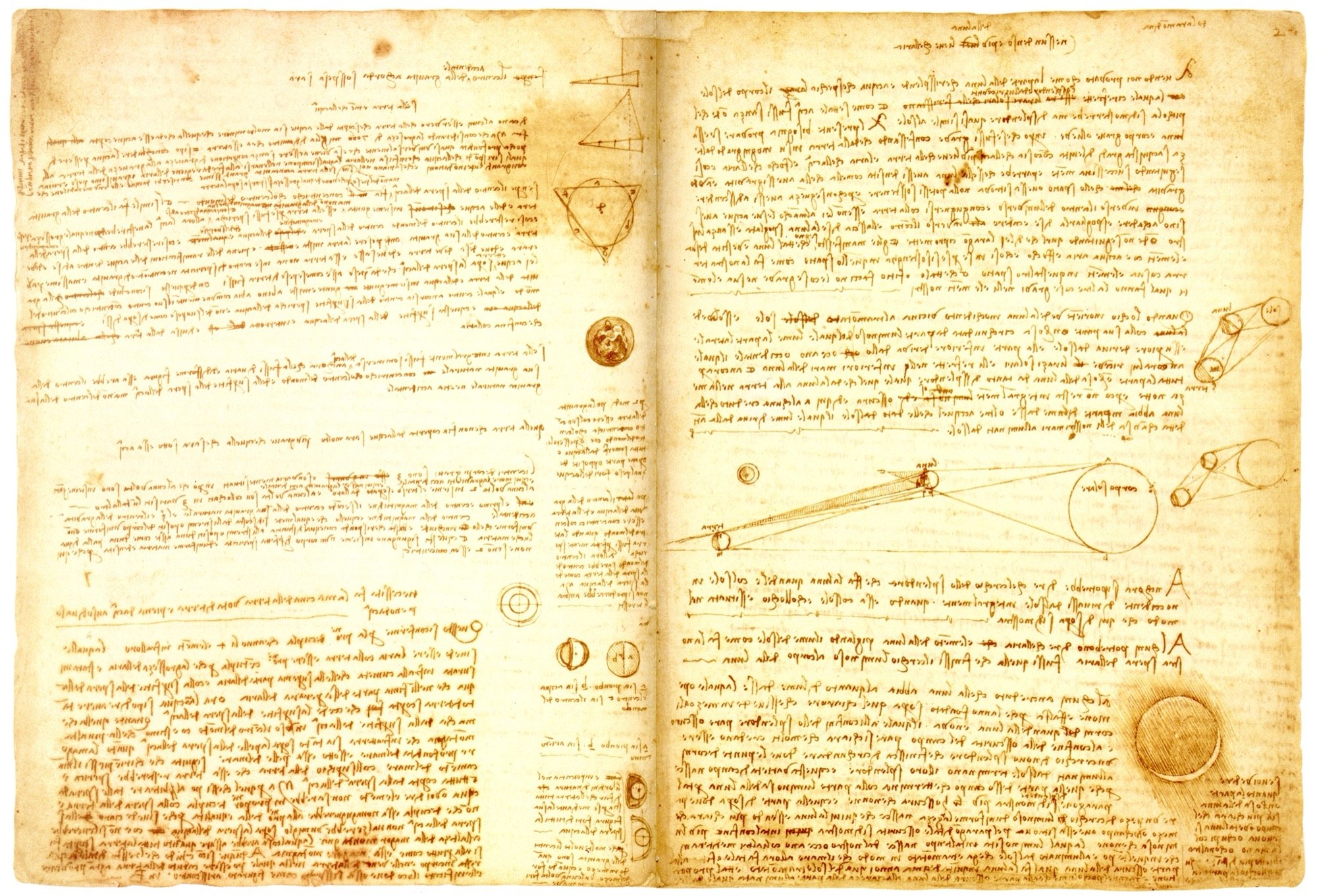
Most of us assume a journal is a place for sentences. But go and look at the notebooks of people who actually changed how the world thinks, and the pages are full of pictures.
Not paintings. Not finished art. Quick boxes, arrows, stick figures, charts, half-finished diagrams. Drawing was not a separate hobby. It was how they thought.
Across the journals of successful people I keep returning to, the same pattern shows up. The figures we now treat as singular geniuses were, in private, scribblers. They drew to understand, to argue, to remember, and to teach themselves new things. Cognitive psychologists have a name for it now. They call it “generative drawing,” and the research suggests it deepens learning in ways pure note-taking does not.
Here are five examples I keep coming back to, and the specific habit each one models.
1. Leonardo da Vinci: Sketches Interwoven with Sentences
Leonardo is the obvious starting point and the most extreme example. Across the roughly 7,200 surviving pages of his notebooks, prose and pictures share the same line of thought. A note about a flood becomes a swirl of water turbulence. A grocery list sits next to a study of a hand. A question about why the sky is blue gets answered with a diagram, not a paragraph.
What I love about Leonardo’s pages is how unprecious they are. He was not laying out a finished argument. He was working something out in real time, and the picture was usually the first move. In my reading of Leonardo’s observational journals, I kept finding small instructions he wrote to himself:
The painter who draws by practice and judgement of the eye, without the use of reason, is like a mirror which copies everything placed in front of it without being conscious of their existence.
The lesson is not “draw better.” It is “draw earlier.” Leonardo did not wait until he understood a thing to sketch it. Sketching was the way he came to understand it. The page was a thinking surface, not a display case.
Try it the next time an entry stalls. Draw the problem instead of describing it. A messy box around an idea. An arrow between two thoughts. It looks like nothing on the page, and it changes what you can see.
2. Richard Feynman: Diagrams on Bar Napkins

Richard Feynman makes the strongest case that drawing is not optional. He was a Nobel Prize-winning physicist who insisted, repeatedly, that he could not think without pictures. There is more on how he ran his notebooks elsewhere on the site; what matters here is the drawing.
…visualization in some form or another is a vital part of my thinking…
Feynman’s most famous invention is a journal artifact. Frustrated by the algebraic mess of quantum electrodynamics, he started sketching particle interactions as little cartoons. Electrons became straight lines with arrows. Photons became wavy lines without them. These doodles became the Feynman diagrams, which the historian of science David Kaiser, in Drawing Theories Apart, describes as having “revolutionized nearly every aspect of theoretical physics.”
The other habit that astonished me was where he drew. The Caltech archive contains scallop-edged placemats stuffed into his notebooks. He liked working at a topless bar near his home, and wrote about it plainly:
There was a period when there were topless restaurants in town…I’d sit in one of the booths and work a little physics on the paper placemats with the scalloped edges, and sometimes I’d draw one of the dancing girls or one of the customers, just to practice.
The dancers and the equations sat on the same page. That, to me, is the real Feynman lesson. Drawing was not a special studio activity. It was as casual as eating. He alternated physics and figure studies the way most of us alternate Twitter tabs.
If you have ever felt that doodling was evidence of a distracted mind, the research disagrees. In a study by the psychologist Jackie Andrade, published in Applied Cognitive Psychology in 2010, people who shaded in shapes while listening to a dull phone message recalled 29 percent more of it than people who just listened. The doodle appears to occupy just enough attention to stop the mind wandering off entirely. Separately, Logan Fiorella and Richard Mayer’s work on generative learning (Learning as a Generative Activity, Cambridge University Press, 2015) found that having students draw what they are reading deepens their understanding of it. Feynman worked this out about fifty years before the psychologists did. It is the same instinct I find in the equation-strewn margins of Einstein’s notebooks: the physicists who saw furthest were the ones who drew the most.
3. W.E.B. Du Bois: Hand-Drawn Data Before Anyone Else

W.E.B. Du Bois is the least obvious name on this list and the one whose pages argue hardest for drawing. His hand-drawn data notebooks deserve their own reading.
In 1900, Du Bois traveled to the Paris Exposition with more than sixty hand-drawn data charts he had prepared with his Atlanta University students. They were vibrant, modernist, almost a century ahead of anything coming out of corporate dashboards today: spiral histograms, color-blocked area charts, a striking timeline of the Jim Crow era. He labeled the collection:
A series of statistical charts illustrating the condition of the descendants of former African slaves now resident in the United States of America.
What is striking about Du Bois is that he drew before he wrote prose. In his Harvard dissertation he stops mid-argument and tells the reader to look at a graph instead:
Let us gather our scattered data for the colonial period, and view it as a whole.
That sentence is the whole philosophy in one line. When the words pile up and the argument stops moving, gather it. View it as a whole. Make the data take up space on a page so you can stand back from it. Du Bois then drew a chart showing how different states handled abolition, and the picture argued more clearly than another paragraph could have.
For Du Bois, drawing was not decoration on top of a finished idea. It was a way of forcing himself to see a pattern he could not yet describe. The same instinct shows up in Edison’s habit of mapping his experiments in his notebooks, and in the structured side-by-side ledgers of Benjamin Franklin’s daily journal. When prose gets stuck, geometry helps.
4. Jane Goodall: Field Sketches of Personalities

Jane Goodall arrived at Gombe in 1960 with almost no formal training and very little equipment. She put it plainly:
I started with paper, pencil and binoculars. Next I acquired a camera, a small telescope and a manual typewriter for transcribing notes.
Her early field notebooks, digitized at Duke University during its Jane Goodall Institute Research Center years and held since March 2022 in the Gombe Chimpanzee Archive at Arizona State University’s Institute of Human Origins, are not glamorous. They are simple, dated, weather-worn pages of observation. But what makes them remarkable is what she chose to draw. She did not just sketch chimps. She sketched specific chimps with names, faces, and recurring quirks: David Greybeard, Flo, Fifi. She kept what amounted to character files, treating each animal as an individual at a time when her scientific community considered that approach unforgivably sentimental.
Her entry for 4 November 1960 captures the method, and the observation it records is the one that changed her field:
By the termite hill were two chimps, both male. I could see a little better the use of the piece of straw. It was held in the left hand, poked onto the ground, and then removed coated with termites.
The accompanying sketch is rough: a few lines for the chimp, an arrow for the straw, an annotation for the termite mound. But that drawing, paired with the description, upended a long-held scientific consensus. Chimpanzees, it turned out, made and used tools. Her tiny field doodle helped redraw the line between humans and the rest of the animal world.
The Goodall lesson is about specificity. She did not write “a chimp ate termites.” She drew this chimp, on this day, doing this thing with his left hand. Drawing a specific moment forces you to notice what generic prose lets you skip.
5. Pablo Picasso: Repetition as Practice

Pablo Picasso filled 175 sketchbooks between 1894 and 1967. He treated them with such importance that he inscribed one of them with a startling line:
Je suis le cahier.
“I am the notebook.” Not “I keep a notebook.” Not “I use a notebook.” I am one.
The clearest example of Picasso’s sketchbook obsession is his preparation for Les Demoiselles d’Avignon, the 1907 painting that arguably launched modernism. To produce that single canvas, he made 809 preliminary studies across 16 sketchbooks. He drew the same five figures over and over, changing one variable at a time: proportions, then poses, then color, then the angle of a nose. His son Claude later described those notebooks as “stepping-stones to trampolines for somersaults.”
Picasso once explained the appeal of the daily sketch this way:
I picked up my sketchbooks daily, saying to myself: “what will I learn of myself that I didn’t know.”
That phrase – what will I learn of myself that I didn’t know – is worth writing on the inside cover of a notebook. Picasso is not waiting to feel inspired. He is using the page to surprise himself. Repetition, in his hands, is not boredom. It is how variation gets discovered. The same logic shows up in Bruce Lee’s relentlessly revised training notebooks and in the rewritten sermon drafts of Martin Luther King Jr.: the masterworks we admire usually sit on top of a private mountain of repetition no one ever saw.
If perfection feels paralyzing, repetition is the antidote. Draw the same thing tomorrow. Draw it badly. Draw it again.
What These Five Have in Common
The longer I sit with these notebooks, the more I think the lesson is not about art. It is about thinking on paper.
Leonardo used drawing to investigate. Feynman used it to explain. Du Bois used it to argue. Goodall used it to notice. Picasso used it to practice. Five different verbs, one shared tool: a pen, a page, and a willingness to make something visible before it was beautiful.
What unites them is that they were not drawing for an audience. The pictures in their journals are private cognitive scaffolding, not portfolio pieces. The usual reason for not sketching in a journal is the imagined critic reading over your shoulder. None of these five were drawing for one.
Try This Tonight
Pick one of the five. My suggestion: start with Du Bois.
Open your journal. Write down something you have been turning over in prose for a while: a decision, an annoyance, a project you cannot get moving. Now stop writing and gather it as a picture. A box, a line, two columns, an arrow. View it as a whole, the way Du Bois told his reader to. Give yourself ninety seconds. Then write one sentence about what you can suddenly see that you could not see before.
That is the technique. It does not require talent. It requires permission.
If you want help building that into a habit, I send a note about the journaling practices of curious people, grounded in primary sources and cognitive research.
Featured image: A spread from Leonardo’s Codex Leicester, folios 35v and 2r. The diagrams are not illustrations added afterwards; they sit inside the argument, in the same run of mirror writing. Public domain, via Wikimedia Commons.


