
A few years ago I made a promise to myself: I would keep a journal like Henry David Thoreau. Every day. No skipping. Walk, observe, write. I gave up at week three. The walks I could manage. The writing I could manage. The two of them stacked on top of each other, daily, until I had filled a small library – that I could not manage.
Thoreau did. From October 1837, when he was twenty, until November 1861, a few months before he died, he kept an almost unbroken journal. Roughly two million words. Forty-seven manuscript volumes. The originals sit today at the Morgan Library & Museum in New York under shelfmark MA 1302, and Princeton University Press has been publishing the full scholarly edition, The Writings of Henry D. Thoreau: Journal, since 1981.
What I find quietly astonishing is that Walden, the book most people know him for, was not the destination of all that writing. It was a tributary. The journal was the main river. Most of Walden was lifted, line by line, from journal pages he had already filled. The journal was the work.
Here are eight lessons from those 47 volumes. None of them require a cabin.
1. Start Because Someone You Trust Asked

Thoreau’s earliest surviving journal notebook, open to entries from November 1837 – a few weeks into the habit Emerson’s question started. Source: The Morgan Library & Museum, MA 1302.
There is a moment that journal-keepers love because it is so plain. On October 22, 1837, Thoreau opened a notebook and wrote:
“What are you doing now?” he asked. “Do you keep a journal?” – So I make my first entry to-day.
Source: Thoreau, Journal, Volume 1: 1837-1844 (Princeton University Press, 1981), p. 5.
The “he” is Ralph Waldo Emerson, his neighbor and mentor in Concord. Emerson was already deep into his own commonplace books (you can read about Emerson’s 263 notebooks here) and he turned to the twenty-year-old Thoreau with a question. The question became a habit. The habit became a life.
I love this entry for a small reason. Thoreau does not write a manifesto. He writes so I make my first entry to-day. The whole thing is one sentence. There is no setup, no apology, no statement of purpose. He just starts.
Most of the journal-keepers I have studied did not begin on their own. Bruce Lee had a sifu and a list of books. Einstein had Mileva. Franklin had a printer’s apprenticeship that taught him to imitate by hand. Almost no one starts a journal alone. Someone asks. Someone shows them. Someone lends them a book.
Try this: If you have been waiting to start a journal, do not write a mission statement. Write the date, write one sentence about what you saw today, and stop. The first page is a doorway, not a building.
2. Treat the Journal as the Main Work, Not a Warm-Up

Thoreau’s painted green writing desk, made around 1838. Most of the two million words crossed this slanted top. Source: The Morgan Library & Museum.
For a long time I thought of journaling as preparation. You journal so you can write the real thing. The book. The essay. The novel. Thoreau quietly contradicts this.
Between 1851 and 1854 – the years right after he left Walden Pond, while he was finishing the book – the journal swells. Entries get longer, denser, more structured. They start to read like finished essays. This is the period when the journal stops being a quarry for other writing and becomes the primary writing itself.
You can feel this in the journal’s own voice:
Says I to my-self should be the motto of my journal.
Source: Thoreau, Journal, November 11, 1851 (Princeton edition, Vol. 4, p. 169).
He was not writing for readers. He was writing for himself, in the most literal way – he was talking to himself on the page, and the talk was the work. Walden was a polished public version of conversations he had already had in private.
This reframed journaling for me. I used to feel guilty when a journal entry did not lead to anything. No essay, no insight, no usable line. Once I started treating the journal as the place where the actual thinking lives – not the warm-up – that guilt dissolved. Sometimes the only “output” is that I understand my own week a little better. Thoreau would be fine with that.
Try this: For one month, do not journal “toward” anything else. No book, no newsletter, no LinkedIn post. Just write the entries. Notice what happens to the quality of your thinking when the journal is not a draft of something else.
3. Walk First. Write Second.

An 1852 hand-colored map of Concord, Massachusetts – the township Thoreau covered on foot, four hours a day, with Walden Pond marked among its woodlots. Source: The Morgan Library & Museum.
Thoreau’s daily structure was famously simple. He walked – often four hours, sometimes longer – and then he came home and wrote. The walk was not break time from writing. The walk was the first half of the writing.
His essay “Walking” (Atlantic Monthly, 1862, but drawn from journal lectures going back to the 1850s) is explicit:
I think that I cannot preserve my health and spirits, unless I spend four hours a day at least – and it is commonly more than that – sauntering through the woods and over the hills and fields, absolutely free from all worldly engagements.
Source: Thoreau, “Walking,” Atlantic Monthly, June 1862. The lecture was drafted from journal entries dating to 1851.
Four hours. I tried this for a week. I averaged ninety minutes, twice, and called it a win. But here is the thing I noticed: on the days I walked first and wrote second, the writing was better. Looser, more specific, more grounded in sense detail. On the days I sat down cold, the writing was straining for something.
Bruce Lee trained his body before he trained his ideas. Edison ran his lab and wrote in his notebooks at the same desk. Leonardo carried a notebook through the streets of Milan. The bodies and the books were not separate. The walking and the writing were one practice.
Try this: Before tomorrow’s journal entry, take a twenty-minute walk – phone in pocket, on silent. When you sit down to write, start with one sentence about something you saw outside that you would not have noticed at your desk.
4. Record What You Saw, Not Just What You Thought
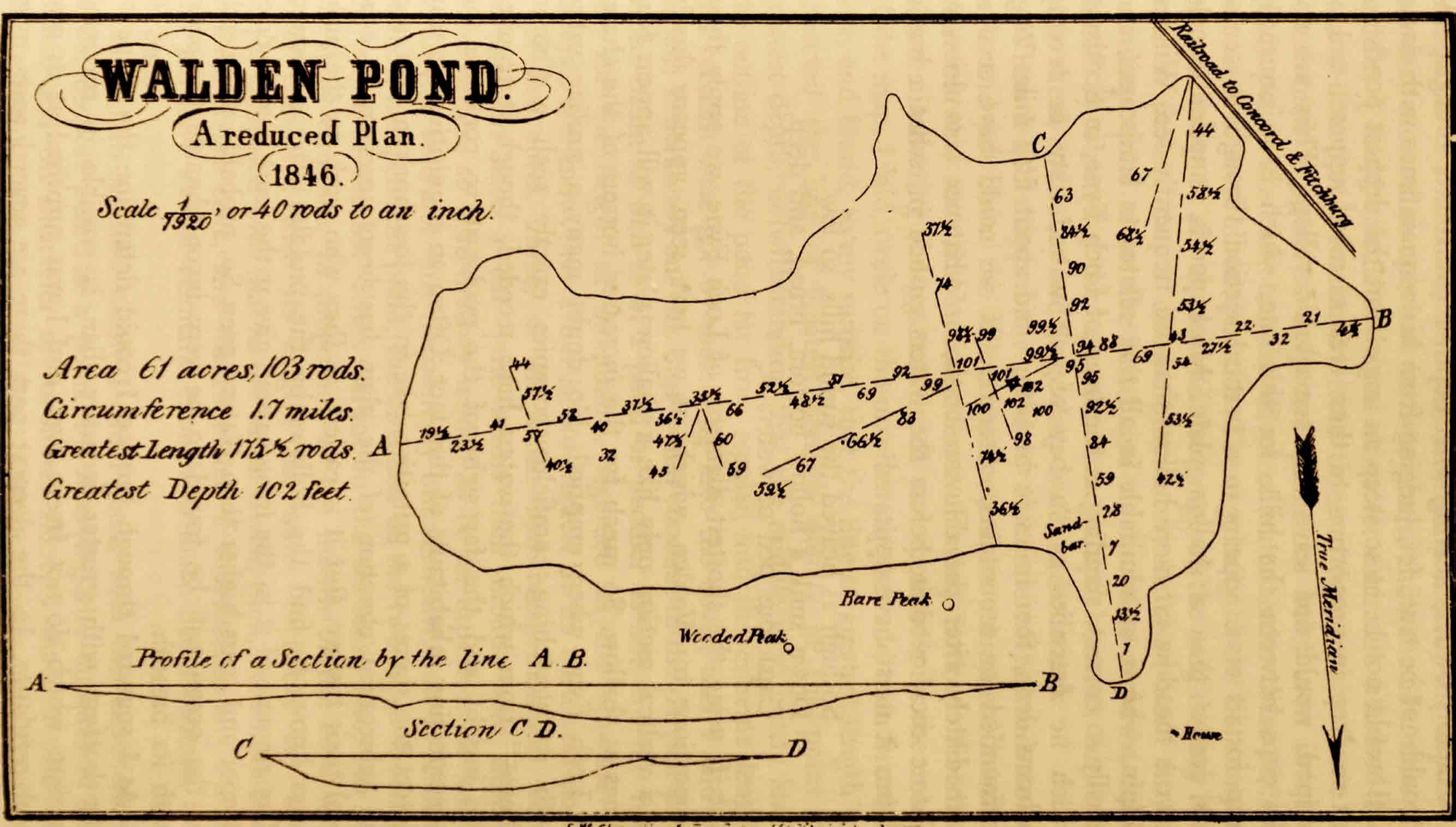
Thoreau’s own 1846 survey of Walden Pond, dotted with his hand-measured depth soundings – greatest depth 102 feet – as printed in the first edition of Walden. Source: Walden; or, Life in the Woods (Ticknor and Fields, 1854), public domain.
Open any volume of the Princeton edition at random and you find weather, light, the sound of a particular bird, a tree someone cut down on the road to Lincoln. The journal is partly a nature notebook. Thoreau measured the depth of Walden Pond by hand. He timed the flowering of plants across multiple springs. He counted bubbles under the ice.
I have hardly begun to live on Staten Island yet; but, like the man who, when forbidden to tread on English ground, carried Scottish ground in his boots, I carry Concord ground in my boots and in my hat,- and am I not made of Concord dust?
Source: Thoreau, letter to Mrs. Emerson, June 20, 1843.
This is the part of his practice that I find most useful. When my own journal turns into a loop of self-analysis, the entries flatten. The cure has been to follow Thoreau out the door. What was the weather. What was on the path. What did the light do at four in the afternoon. The physical world steadies the writing, the way a tripod steadies a camera.
There is a reason climate scientists today still mine his journals for phenology data – the dates he recorded for blooming plants are useful 170 years later because he wrote down the specific, the small, and the dated. He treated the visible world as worth recording for itself.
Try this: Open today’s entry with one sentence about weather. Not “it was nice.” Specifics. The wind came from the northwest and the maple on the corner had lost a third of its leaves overnight. Notice how the rest of the entry behaves differently.
5. Use the Journal as a Philosophical Workshop

An early draft page of Walden in Thoreau’s hand: “At the time the following pages were written, I lived alone in the woods, a mile from any neighbor… on the shore of Walden Pond.” Source: The Morgan Library & Museum.
The journal is not only a nature notebook. It is also the place where Thoreau worked out ideas that later became Walden, Civil Disobedience, and dozens of lectures and essays. Lines you know by heart from the books appear first in the journal, rougher, often more interesting.
I went to the woods because I wished to live deliberately, to front only the essential facts of life, and see if I could not learn what it had to teach, and not, when I came to die, discover that I had not lived.
Source: Thoreau, Walden (1854), “Where I Lived, and What I Lived For.” The thought is foreshadowed in journal entries from July and August 1845, written during his first weeks at Walden Pond (Princeton edition, Vol. 2).
The famous sentence is not a flash of inspiration. It is the polished surface of a thought he had been turning over in the journal for years. The journal was where the rough version got rougher and then, slowly, less rough.
This is the model I keep coming back to when I want to write something serious. The polished thing in public is the iceberg’s tip. The journal is the iceberg. Martin Luther King’s sermon notebooks worked the same way – phrases that became I Have a Dream appear earlier and quieter on private pages.
Try this: Pick one question you keep turning over in your head – about work, about a relationship, about a decision. Write about it once a week for a month, in the same journal, in your own messy language. At the end of the month, read all four entries in one sitting. The polished version is the one you have not written yet.
6. Let the Journal Outgrow Its First Purpose

A late journal volume (1858-1859), crowded with observations and a carefully sketched hawk feather. The later books grew wilder as the practice deepened. Source: The Morgan Library & Museum.
Thoreau’s journal began as a writer’s notebook – quotations, ideas, scraps. In the 1850s it widened. It became nature observation, social commentary, dream record, scientific data, autobiography, sermon, joke book. It refused to specialize – it was never strictly structured or purely free-flow.
The Morgan Library’s manuscript holdings, MA 1302, show this physically. The volumes change shape over time. Earlier volumes are tidier. Later ones are crowded with measurements, sketches, pressed leaves, lists of species. The book grew with the man. That physical record is a quiet argument for writing by hand.
I think about this when people ask me what a journal is “for.” There is a temptation to pick a single purpose – gratitude, productivity, processing emotions – and then quit when the purpose stops fitting. Thoreau’s journal worked because he let it be more than one thing at a time. It was allowed to drift.
My Journal is that of me which would else spill over and run to waste, gleanings from the field which in action I reap.
Source: Thoreau, Journal, February 8, 1841 (Princeton edition, Vol. 1, p. 277).
What spills over. What you would have wasted otherwise. That is a generous definition of a journal. It does not require the day to have been important.
Try this: Look at your last twenty journal entries. Are they all the same shape – same prompt, same length, same topic? Try writing one entry this week that does not fit your usual format. A list. A map. A description of a stranger. A bad drawing. See if the journal will accept it. It will.
7. Trust That the Reader You Are Writing For Is You Later
One of the hardest things about a long journal habit is the question of audience. Who is this for? If it is for no one, why keep it? If it is for posterity, you start performing.
Thoreau split the difference in a way I find useful. He wrote, more or less, for a later version of himself. The journal was both a record and a correspondent. He talked to it. He talked back. Entries from 1851 reference entries from 1841. The book remembered things he had forgotten.
Each thought that is welcomed and recorded is a nest egg, by the side of which more will be laid.
Source: Thoreau, Journal, January 22, 1852 (Princeton edition, Vol. 4, p. 277).
A nest egg. Not a finished essay. Not a polished memory. Something small that produces more of itself if left alone. That is what a journal entry is. The audience is the older you who will come back and find it there.
This is also why Octavia Butler’s affirmation journals and Frederick Douglass’s record-keeping and Thoreau’s 47 volumes all share a strange property: the writer is the first reader, and often the only one who needs to be.
Try this: In tomorrow’s entry, write one paragraph addressed to yourself a year from now. Tell that person what you are wrestling with this week, in plain language. Do not explain why – just say it. When you come back to the page in twelve months, you will know what to do with it.
8. Write Until You Stop, Then Be Glad You Wrote

The journal’s last pages. The final entry is dated November 3, 1861; the leaves after it are blank. Source: The Morgan Library & Museum.
Thoreau’s last journal entry is dated November 3, 1861. He died of tuberculosis the following May. The final entry describes a strong storm and what the wind had done to the gravel in the railroad cut. It is not a deathbed entry. It is a weather entry. He was still doing the work.
This affects me. There is no big closing scene. He did not “finish” his journal. He just stopped, because his body did, and the last day was like the others – a man watching the wind move dirt and writing it down. He had no idea those forty-seven volumes would be preserved, edited, mined for Walden, studied for climate data, held in a museum.
What he had was the practice. The walks. The pages. The next entry. That was the whole thing.
I tried to keep a journal as long as Thoreau and quit at week three. I am now in year seven of a different journal – not daily, not 2,000,000 words, but mine. Whenever I think about giving up on it I remember that the value was never going to come from the volume. It comes from the next entry. Forty-seven manuscript books were just one entry, forty-seven thousand times.
Try this: Do not commit to a year. Do not commit to a month. Commit to the next entry. Then commit to the one after that. That is all Thoreau ever did.
A Closing Thought
If you want to read Thoreau’s journal directly, Princeton’s Writings of Henry D. Thoreau: Journal is the scholarly edition (multiple volumes published since 1981, more in progress). The Morgan Library holds the originals as MA 1302 and has digitized selected pages.
What strikes me most, after a few weeks of trying to read along with him, is how undramatic the practice was. He walked. He came home. He wrote. He repeated. The drama is in the cumulative shape. Two million words, eight thousand or so days, one quiet habit.
It is the same shape, at heart, as Edison’s 3,500 notebooks, Leonardo’s notebooks of observation, Bruce Lee’s training journals, Franklin’s commonplace pages, and King’s sermon notebooks. Different vocabularies. Same instinct. Show up to the page, day after day, and let what you become there be more important than what you publish from there.
If reading this made you want to start, the simplest first move is to write tomorrow’s date and one sentence about the weather. Thoreau would have approved.
And if Thoreau’s journal made you want to see how other famous writers, scientists, and artists used theirs, the full roster of famous journal-keepers is worth a look.
If you want a small nudge in your inbox – notes on journaling practice, primary-source stories from people like Thoreau, prompts you can actually use – you can join the journaling newsletter here. It is free, and it is the closest thing to having Emerson lean over and ask, “Do you keep a journal?”
Featured image: Henry David Thoreau in June 1856, photographed by Benjamin D. Maxham. By then he had been keeping the journal for nearly two decades. Source: National Portrait Gallery, Smithsonian Institution.


